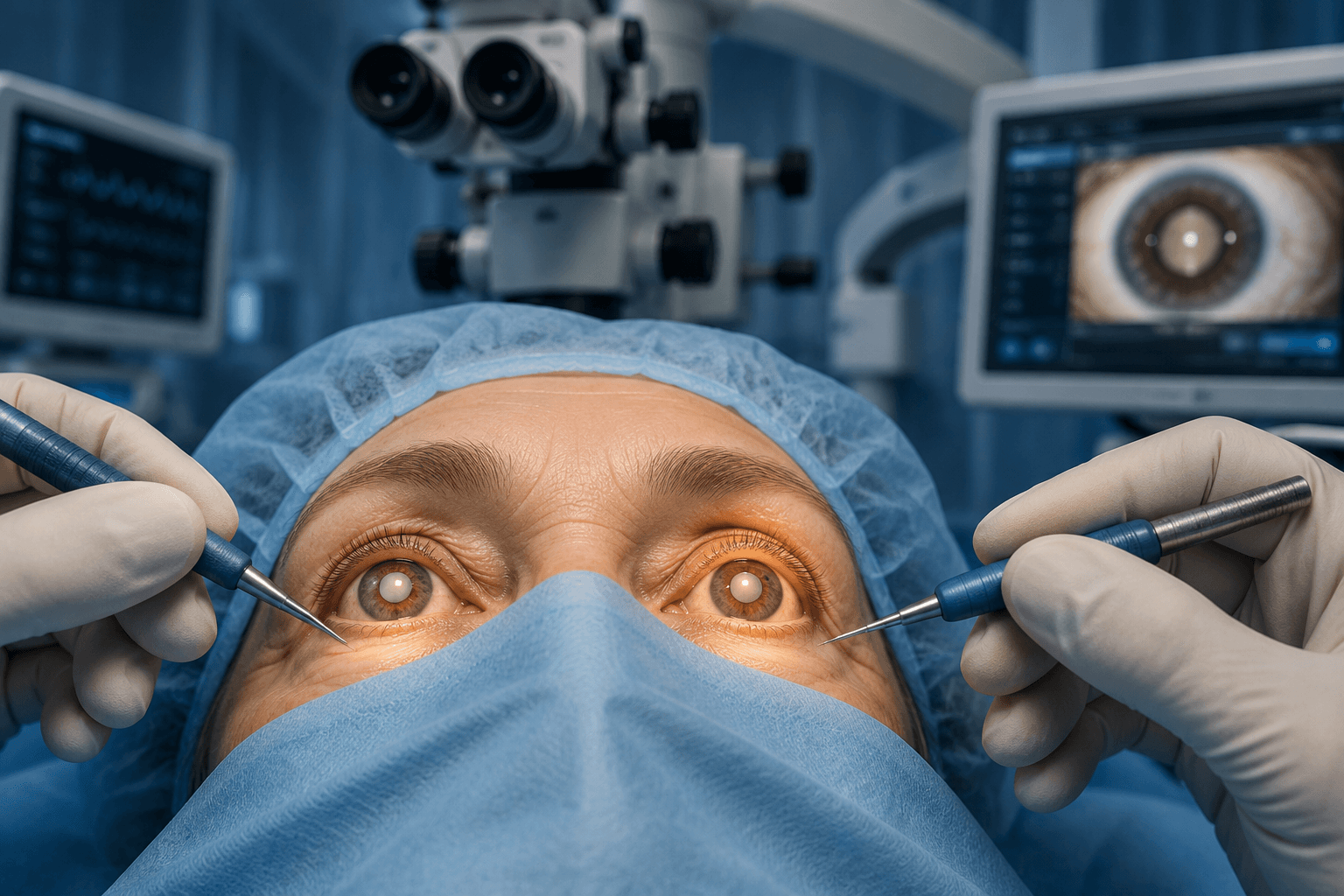
Day of Surgery: What to Expect
Cataract surgery is a day-procedure — you arrive, have the operation, and go home the same day. You will need someone to drive you home; you cannot drive after sedation or with the eye patched. Most surgeries take 10 to 20 minutes per eye.
Immediately after surgery you will have a protective shield or patch placed over the eye. Vision will typically be blurry or foggy due to a combination of the dilating drops used during surgery and normal post-operative corneal swelling. This is expected and begins to improve within hours.
- • Rest at home for the remainder of the day
- • Do not drive or operate machinery
- • Avoid rubbing or pressing on the eye
- • Keep the protective shield in place as instructed (often worn during sleep for the first week)
- • Begin your prescribed eye drops that evening or as instructed
Days 1–7: Vision Improving, Routine Establishing
Vision typically improves noticeably within the first 24 to 48 hours, though it may fluctuate. A mild gritty or sandy sensation is normal — the small incision in the eye is healing. Light sensitivity is common and usually improves over the first week. Colours may appear noticeably brighter and more vivid than before surgery, which can be slightly surprising.
Your first post-operative appointment is usually within 1 to 2 days of surgery. Your surgeon will check intraocular pressure, confirm the IOL position, and assess how the eye is healing. Subsequent review appointments are typically at 1 week, 1 month, and 3 months — though this varies by practice.
Normal symptoms in Week 1:
- • Gritty, sandy, or mildly scratchy sensation
- • Mild light sensitivity
- • Watery eyes
- • Mild redness of the white of the eye (subconjunctival haemorrhage)
- • Occasional blurred or fluctuating vision
- • A mild foreign body sensation, particularly in the morning
Weeks 2–4: Settling and Stabilising
By the second week, most patients feel close to normal. Gritty sensations and light sensitivity have largely resolved. Vision continues to improve and stabilise, though some degree of fluctuation can persist for 4 to 6 weeks as the cornea fully recovers.
Dry eye is extremely common during this period and can cause blurry or fluctuating vision that improves with lubricating eye drops. Use preservative-free artificial tears freely throughout the day if needed — they will not interfere with your prescribed drops.
Do not update your glasses prescription during this period. Wait until your vision has fully stabilised — usually at or after your 4–6 week review — before investing in new spectacles.
Month 3: Full Recovery
By 3 months, the eye is fully healed and vision has reached its final stable outcome. Your 3-month check is an appropriate time to finalise your glasses prescription if required. Most patients are delighted with the clarity of their vision at this stage, particularly those who had dense cataracts affecting their vision for months or years.
In the years that follow, a proportion of patients — roughly 20% — may develop posterior capsule opacification (PCO), a hazy film on the remaining posterior lens capsule that can mimic a return of the cataract. This is not the cataract returning; it is treatable with a quick, painless outpatient YAG laser procedure.
Activities Guide: What You Can and Cannot Do
| Status / Notes | Why | |
|---|---|---|
| Watching TV / screens | Yes, from day one — take regular breaks if eyes feel tired | N/A |
| Reading | Yes, from day 1 to 2 once vision settles | N/A |
| Walking outdoors | Yes, from day one — wear sunglasses | N/A |
| Light household tasks | Yes, from day one — avoid bending below waist | N/A |
| Driving | Yes, once your surgeon confirms adequate visual acuity (usually 1–2 weeks) | Not until cleared by your surgeon |
| Returning to desk work | Usually within a few days | N/A |
| Swimming / spas / hot tubs | Not for 4 weeks minimum | Avoid — risk of infection |
| Heavy lifting (>5 kg) | Not for 2 weeks | Avoid — increases intraocular pressure |
| Rubbing the eye | Never — even after full healing | Risk of IOL displacement and wound disruption |
| Dusty / dirty environments | Avoid for 2 weeks | Risk of infection and irritation |
| Contact sports | Not for 4 weeks minimum | Risk of trauma to healing eye |
Questions about your recovery?
Your post-operative appointments are the best time to ask questions. Our team is also available by phone if concerns arise between visits.
Eye Drops Regimen
After cataract surgery you will be prescribed a course of eye drops, typically combining an antibiotic and an anti-inflammatory (steroid or NSAID). The regimen varies slightly between surgeons and hospitals, but a common schedule is:
- • Antibiotic drops (e.g. chloramphenicol or moxifloxacin): 4 times daily for 2–4 weeks
- • Anti-inflammatory drops (e.g. prednisolone or ketorolac): 4 times daily, tapered over 4 weeks
- • Lubricating drops (preservative-free): as often as needed for comfort
It is important to use the drops exactly as prescribed and to complete the full course. Leave at least 5 minutes between different eye drops to avoid diluting the medication. Always wash your hands before applying drops and avoid touching the dropper tip to your eye.
Setting reminders for drops
Warning Signs: When to Contact Your Surgeon
Contact your surgeon immediately if you experience:
- • Sudden, significant loss of vision in the operated eye
- • Increasing pain or pressure that is not relieved by paracetamol
- • Increasing redness that is getting worse rather than better
- • A significant increase in floaters, new flashing lights, or a dark curtain across part of your vision
- • Discharge from the eye (sticky or coloured)
- • Swelling of the eyelids that is getting worse
Most of these symptoms will not occur, and cataract surgery has a very high safety record. However, early detection and treatment of the rare complication such as endophthalmitis (infection inside the eye) is critical — this is a genuine emergency that requires same-day assessment.
Frequently Asked Questions
You cannot drive on the day of surgery and should not drive until your surgeon confirms that your vision in the operated eye meets the legal standard for driving. This is typically confirmed at your first post-operative appointment, often 1 to 2 weeks after surgery. Your other eye’s vision also plays a role — if it is poor, you may need to wait until the second eye has been treated. Never self-assess your driving fitness after surgery.

Written by
Dr Parth ShahDr Parth Shah is a subspecialty-trained Canberra ophthalmologist with expertise in cataract surgery, paediatric eye care and strabismus surgery.
Medical disclaimer: This article is for educational purposes only and does not constitute medical advice, diagnosis, or treatment. Always consult a qualified ophthalmologist or healthcare professional regarding any eye condition or before making any healthcare decisions. Read our full disclaimer.
Ready to start your cataract journey?
Book a comprehensive assessment with Dr Parth Shah at Clarity Eye Surgeons in Canberra.