The Developing Visual System
At birth, visual acuity is very poor — approximately 6/200 — and improves steadily as the visual cortex matures through normal visual experience. This process is most rapid in the first two years of life and continues until approximately age seven to eight, a period known as the critical period of visual development.
Any condition that prevents clear, sharp images from forming on the retina during this window — whether from a cataract, a large refractive error, or a misaligned eye — can cause amblyopia(lazy eye): a permanent reduction in the brain’s ability to interpret signals from that eye. The critical window cannot be reopened after it closes.
1 in 50
Children affected by amblyopia
7–8 years
Approximate close of the critical visual development window
Early
Treatment is most effective before age 7
Common Paediatric Eye Conditions
The following conditions represent the most frequently encountered problems in paediatric ophthalmology practice:
1. Amblyopia (Lazy Eye)
The most common cause of visual impairment in children. Amblyopia arises when the brain fails to develop normal processing from one eye due to abnormal visual input — from a refractive error, strabismus, or deprivation (e.g., cataract). Treatment involves correcting the underlying cause and penalising the fellow eye with patching or atropine drops.
2. Strabismus (Squint)
Misalignment of the visual axes. Esotropia (inward turn) is most common in children; exotropia (outward drift) is often intermittent. Strabismus causes amblyopia by triggering the brain to suppress the deviating eye. Treatment includes glasses, patching, and in many cases surgery to realign the muscles.
3. Refractive Errors
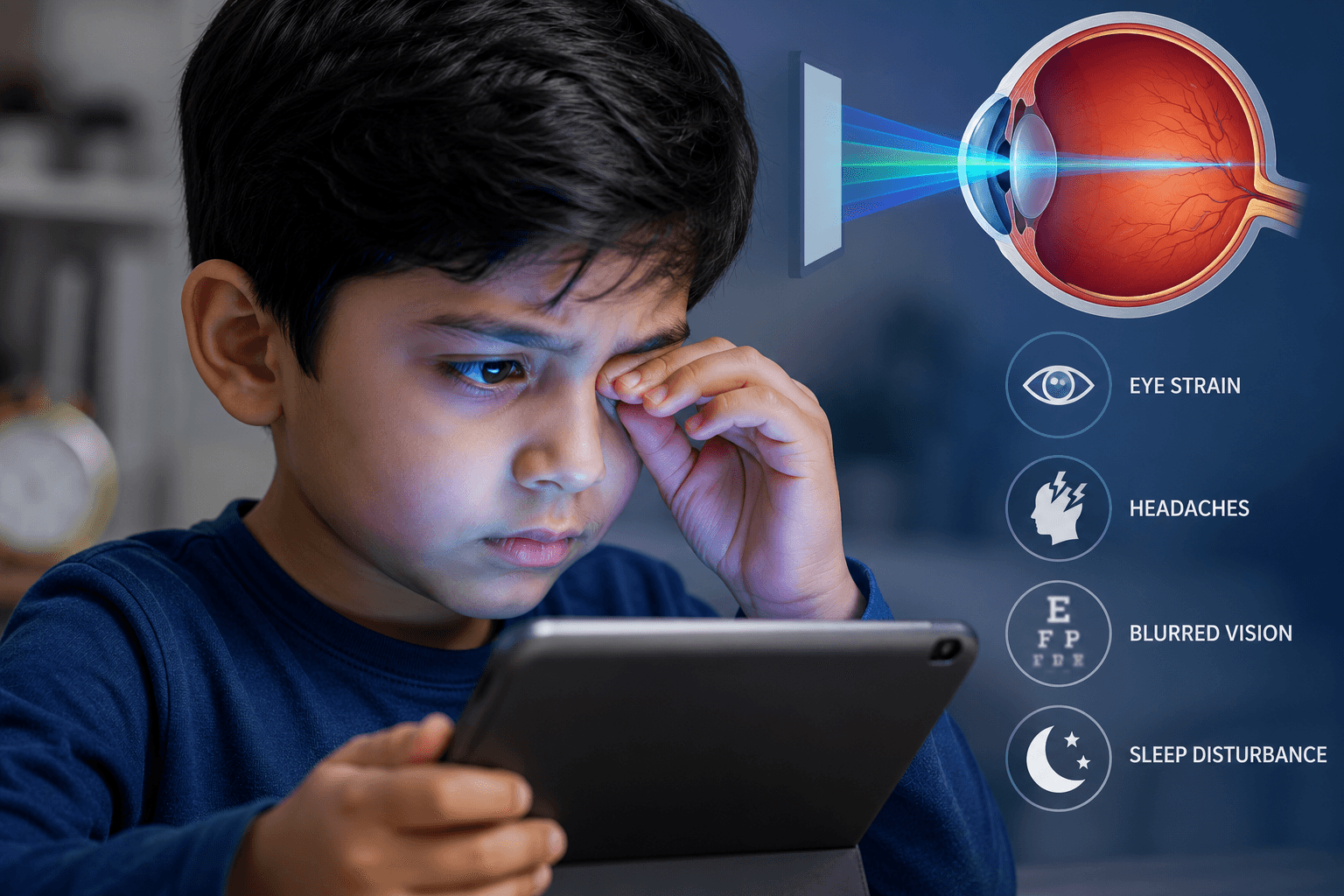
Myopia (short-sightedness) has risen sharply in prevalence over recent decades. Hyperopia (long-sightedness) is common in young children and may cause accommodative esotropia if significant. Astigmatism causes blurred vision at all distances. All require careful assessment and glasses prescription.
4. Congenital Cataracts
A white or cloudy lens present from birth or developing in early infancy. Dense cataracts require urgent surgical removal within weeks to prevent irreversible deprivation amblyopia. Post-operative patching and optical correction are essential.
5. Ptosis (Drooping Eyelid)
A congenitally drooping upper eyelid that covers the pupil can prevent a clear image from reaching the retina, causing deprivation amblyopia. Surgical repair of the eyelid is required, followed by amblyopia treatment.
6. Blocked Tear Ducts (Nasolacrimal Duct Obstruction)
Very common in infants, causing a watery, sticky eye. The majority resolve spontaneously by 12 months with massage and drops. Persistent obstruction may require probing of the nasolacrimal duct.
7. Nystagmus
Involuntary, rhythmic eye movements. May be congenital or acquired. Causes include sensory deprivation (cataract, optic nerve abnormality), neurological conditions, and idiopathic. Treatment targets the underlying cause where possible.
8. Retinopathy of Prematurity (ROP)
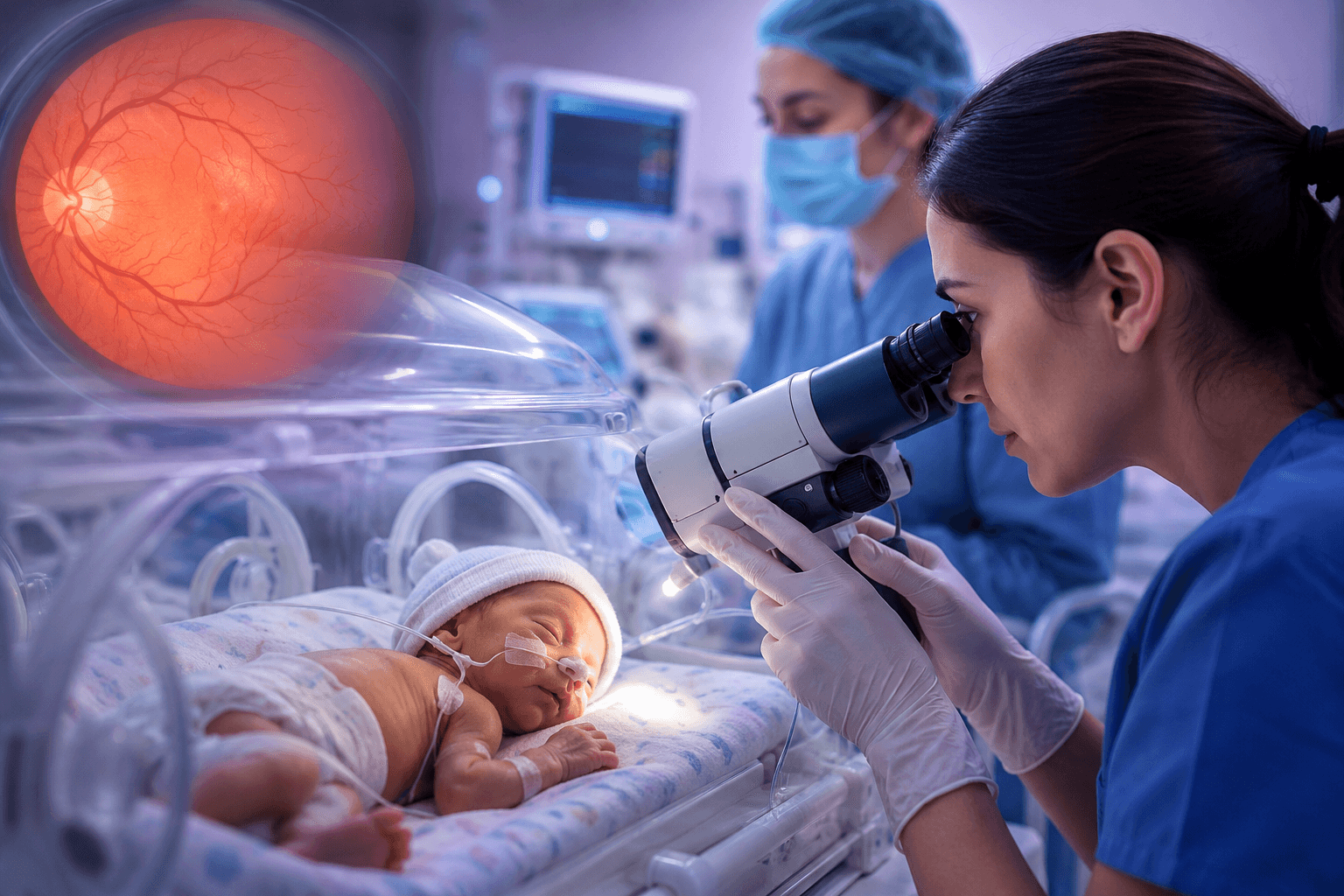
Abnormal retinal vessel growth in premature infants. All infants born before 32 weeks or under 1,500 g require scheduled retinal screening. Severe ROP is treated with laser or anti-VEGF injection to prevent retinal detachment.
9. Retinoblastoma
A rare but life-threatening intraocular tumour of early childhood. The classic presentation is leukocoria (white pupil reflex) or strabismus in a child under five years. Any white pupil is an urgent referral until retinoblastoma is excluded.
When to Refer: Red Flags and Triggers
Seek urgent ophthalmology review for any of the following
- • White or cloudy pupil (leukocoria) — urgent: rule out cataract and retinoblastoma
- • Any squint noticed by parents or carer — refer promptly, not to a “wait and see” approach
- • Poor tracking or failure to fix and follow by 6–8 weeks of age
- • Failed school vision screen — requires formal assessment
- • Nystagmus — involuntary eye movements at any age
- • Family history of amblyopia, strabismus, or congenital cataract
Concerned about your child’s eyes?
A comprehensive paediatric eye assessment with Dr Parth Shah provides clarity on your child’s visual health and any treatment needed.
What Makes Paediatric Eye Examinations Different
Examining a child’s eyes requires different techniques and patience compared to adult ophthalmology. Children cannot reliably respond to standard adult vision tests, especially infants and toddlers. Paediatric assessments typically involve:
- Cycloplegic refraction— dilating drops are instilled to relax accommodation, revealing the true refractive error that children naturally mask by over-focusing.
- Cover test— assessing for strabismus by alternately covering each eye and observing movement.
- Red reflex assessment— a bright light shone through a dilated pupil; absence or asymmetry indicates cataract, retinoblastoma, or retinal pathology.
- Age-appropriate visual acuity testing — using Cardiff cards for infants, picture charts for toddlers, and Snellen charts for school-age children.
- Orthoptist assessment— a specialist allied health professional who measures binocular vision, eye movements and visual acuity in detail.
Sedation or general anaesthesia is occasionally required for very young or uncooperative children when a thorough examination cannot be achieved in the outpatient setting.
Frequently Asked Questions
A newborn red reflex check should occur before hospital discharge. Children at high risk (family history of amblyopia, strabismus or congenital cataract) should be reviewed at 6–12 months. All children benefit from a vision assessment at 3–4 years before starting school, with regular checks thereafter.

Written by
Dr Parth ShahDr Parth Shah is a subspecialty-trained Canberra ophthalmologist with expertise in cataract surgery, paediatric eye care and strabismus surgery.
Medical disclaimer: This article is for educational purposes only and does not constitute medical advice, diagnosis, or treatment. Always consult a qualified ophthalmologist or healthcare professional regarding any eye condition or before making any healthcare decisions. Read our full disclaimer.
Book a paediatric eye assessment
Early diagnosis and treatment gives children the best possible chance of normal visual development.