Table of Contents
ToggleLaser vs Traditional cataract surgery: Which is better?
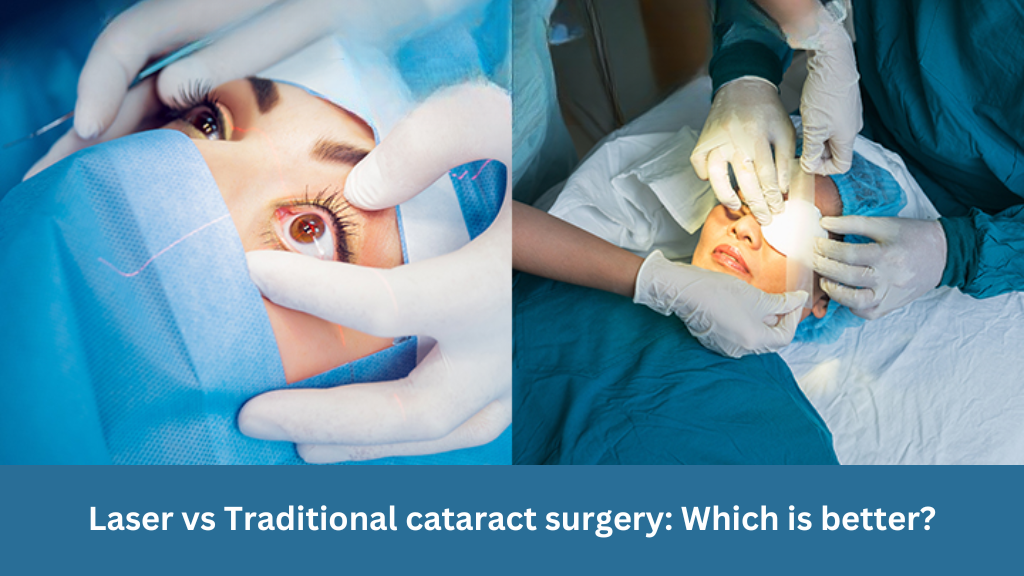
Cataract surgery is one of the most commonly performed eye procedures worldwide. With advancements in medical technology, patients now have two primary options: traditional phacoemulsification (manual surgery) and laser-assisted cataract surgery (femtosecond laser technology).
Both methods aim to restore clear vision by replacing the eye’s cloudy lens with an artificial intraocular lens (IOL). However, there are key differences in technique, precision, safety, recovery, and cost that can influence a patient’s decision.
In this comprehensive guide, we compare traditional and laser cataract surgery, discuss recent advancements, and provide expert insights to help you choose the best option.
Understanding traditional cataract surgery (Phacoemulsification)
Traditional cataract surgery has been the gold standard for decades. The process involves:
- Manual incision: The surgeon makes a small incision in the cornea using a handheld surgical blade.
- Lens fragmentation: An ultrasonic probe (phacoemulsifier) is inserted to break up the cloudy lens using ultrasound waves.
- Lens removal: The fragmented cataract is suctioned out through the small incision.
- Artificial lens implantation: An intraocular lens (IOL) is implanted to restore clear vision.
- Healing process: The small incision is self-healing and rarely requires stitches.
Advantages of traditional cataract surgery
- Proven effectiveness: Performed for decades with high success rates.
- Widely available: Most ophthalmologists are trained in this method.
- Lower cost: Generally less expensive than laser-assisted surgery.
- Short surgery time: Takes around 10–20 minutes per eye.
Limitations of traditional cataract surgery
- Manual incision: Less precision compared to a laser.
- More energy use: Requires higher ultrasound energy, which may slightly increase inflammation.
- Potential for human error: Although rare, manual incisions can vary in accuracy.
Understanding laser-assisted cataract surgery
Laser-assisted cataract surgery uses a femtosecond laser to automate key steps of the procedure, increasing precision and safety. The steps include:
- Laser-guided incision: The laser makes a precise corneal incision.
- Capsulotomy: The laser creates a perfectly circular opening in the lens capsule to access the cataract.
- Lens fragmentation: The laser pre-softens the cataract before removal, reducing the need for ultrasonic energy.
- Lens removal & IOL implantation: The softened lens is removed and replaced with an IOL.
Advantages of laser cataract surgery
- Higher precision: The laser creates more accurate and reproducible incisions.
- Less energy required: Pre-softening of the cataract reduces ultrasound energy, leading to faster healing.
- Customisable: The procedure is tailored to each patient’s eye anatomy.
- Better astigmatism correction: Can correct mild astigmatism with precise corneal incisions.
- Reduced risk of complications: Potentially lowers risks of capsule rupture and inflammation.
Limitations of laser cataract surgery
- Higher cost: More expensive than traditional surgery and often not covered by insurance.
- Not always necessary: Many patients achieve excellent results with traditional surgery.
- Longer procedure time: The added laser steps increase overall surgery time.
Comparison: Traditional vs. Laser cataract surgery
Aspect | Traditional Cataract Surgery | Laser Cataract Surgery |
Surgical Method | Manual incisions and ultrasound. | Laser incisions and pre-fragmentation of the cataract. |
Precision | Surgeon-controlled | Computer-guided for greater accuracy. |
Energy Used | Requires higher ultrasound energy. | Uses less energy due to pre-softening. |
Recovery Time | Typically fast (1–2 weeks) | May be slightly faster. |
Customisation | Follows a standard technique. | Tailored to each patient’s eye shape. |
Risk of Complications | Low risk | May further reduce the risk, however additional steps carry some additional risks. |
Cost | More affordable | More expensive due to additional laser technology. |
Time | Longer time due to additional steps and need for separate laser instrumentation. |
Recent advancements in cataract surgery
1. Bilateral same-day cataract surgery
Traditionally, cataract surgery is performed on one eye at a time. However, new protocols allow for same-day surgery for both eyes, reducing hospital visits and recovery time.
2. No-drop cataract surgery
Patients now have the option of dropless cataract surgery, where a single steroid injection is used instead of post-surgery eye drops, making recovery simpler.
3. Premium Intraocular Lenses (IOLs)
New IOLs provide enhanced vision correction for presbyopia and astigmatism, reducing the need for glasses after surgery.
Why choose Clarity Eye Surgeons in Canberra?
Clarity Eye Surgeons in Canberra specialises in cataract surgery, offering state-of-the-art technology and customised surgical solutions for optimal visual outcomes. With expertise in advanced cataract techniques and personalised treatment plans, we ensure comprehensive pre- and post-operative care for every patient.
Conclusion
Both traditional and laser-assisted cataract surgery are highly effective in restoring clear vision.
At Clarity Eye Surgeons in Canberra, we specialise in traditional cataract surgery, using state-of-the-art technology to deliver the best possible visual outcomes. Our expert team provides personalised treatment plans and comprehensive pre- and post-operative care to ensure a smooth recovery.
Schedule a consultation with Clarity Eye Surgeons to discuss your options and find the best cataract surgery for your needs.
Author bio
Dr Parth Shah is a leading ophthalmologist in Canberra, specialising in cataract surgery. With extensive training and experience, he is renowned for his expertise in the field. Dr Shah is dedicated not only to performing successful surgeries but also to patient education. His compassionate approach, combined with technical proficiency, has earned him the trust and gratitude of countless patients. He is a true advocate for eye health and a trusted name in the Canberra ophthalmology community.
FAQs
Both procedures are considered very safe, with low complication rates.
No, cataract surgery (both traditional and laser) should be painless. Patients receive numbing eye drops, and mild sedation may be used for comfort. Some may experience slight pressure.
Traditional cataract surgery is usually covered by Medicare and private insurance. However, laser-assisted surgery and premium IOLs may have additional out-of-pocket costs.
Patients with astigmatism or those seeking enhanced precision may benefit from laser cataract surgery. However, factors such as eye health, medical history, and budget should be discussed with an ophthalmologist to determine the best option.
No, you should not drive immediately after the surgery. Most patients regain sufficient vision within 24–48 hours, but it’s recommended to wait until your doctor confirms your vision is safe for driving.
While most patients experience significant improvement in vision within a few days, complete healing can take up to 4–6 weeks. Your doctor will monitor your progress and provide specific guidelines for post-operative care.
Other blogs related to Cataract
Bilateral cataract surgery (both eyes): Pros, cons, timing — is it better to do one eye at a time or both together?
Table of Contents Toggle Introduction Symptoms of childhood cataracts Causes of cataract in children What Is Cataract Surgery in Children? What Are the Risks of
Cataract surgery for high myopia, high hyperopia and other refractive errors
Table of Contents Toggle What is Retinal Detachment? Causes of Retinal Detachment Symptoms of Retinal Detachment Diagnosis of retinal detachment Treatment Options for Retinal Detachment
Premium Intraocular Lenses (IOLs): Enhancing vision Post-Cataract surgery
Table of Contents Toggle Introduction Symptoms of childhood cataracts Causes of cataract in children What Is Cataract Surgery in Children? What Are the Risks of
Can you have cataract surgery in both eyes at the same time?
Table of Contents Toggle Introduction Symptoms of childhood cataracts Causes of cataract in children What Is Cataract Surgery in Children? What Are the Risks of
How long after cataract surgery can I see clearly?
Table of Contents Toggle Introduction Symptoms of childhood cataracts Causes of cataract in children What Is Cataract Surgery in Children? What Are the Risks of
Can cataracts grow back after surgery? Myths, facts, and what patients should know
Table of Contents Toggle Introduction Symptoms of childhood cataracts Causes of cataract in children What Is Cataract Surgery in Children? What Are the Risks of
Bloodshot eyes after cataract surgery: Causes, recovery, and when to seek help
Table of Contents Toggle Introduction Symptoms of childhood cataracts Causes of cataract in children What Is Cataract Surgery in Children? What Are the Risks of
What are the different types of lens for cataract Surgery?
Table of Contents Toggle Introduction Symptoms of childhood cataracts Causes of cataract in children What Is Cataract Surgery in Children? What Are the Risks of
What to know about posterior subcapsular cataracts?
Table of Contents Toggle Introduction Symptoms of childhood cataracts Causes of cataract in children What Is Cataract Surgery in Children? What Are the Risks of
What does vision look like with cataracts?
Table of Contents Toggle Introduction Symptoms of childhood cataracts Causes of cataract in children What Is Cataract Surgery in Children? What Are the Risks of
5 Essential Things to Know About Glasses After Cataract Surgery
Table of Contents Toggle Introduction Symptoms of childhood cataracts Causes of cataract in children What Is Cataract Surgery in Children? What Are the Risks of
Cortical cataracts: Symptoms, Causes, Treatment, and More
Table of Contents Toggle What are cortical cataracts? Symptoms of cortical cataracts Causes and Risk factors How are cortical cataracts diagnosed? Treatment options Recovery after
Laser vs Traditional cataract surgery: Which is better?
Table of Contents Toggle Introduction Symptoms of childhood cataracts Causes of cataract in children What Is Cataract Surgery in Children? What Are the Risks of
Cataract surgery & Aging: What seniors should know?
Table of Contents Toggle Introduction Symptoms of childhood cataracts Causes of cataract in children What Is Cataract Surgery in Children? What Are the Risks of
Cataract surgery and Aging: What patients should know
Table of Contents Toggle Introduction Symptoms of childhood cataracts Causes of cataract in children What Is Cataract Surgery in Children? What Are the Risks of
The impact of cataract surgery on night vision
Table of Contents Toggle Introduction Symptoms of childhood cataracts Causes of cataract in children What Is Cataract Surgery in Children? What Are the Risks of
Cataract surgery myths debunked
Table of Contents Toggle Myth 1: Cataracts must be “mature” before surgery Myth 2: Cataract surgery is painful Myth 3: Recovery takes a long time
Is Cataract Surgery Painful?
Table of Contents Toggle Introduction Symptoms of childhood cataracts Causes of cataract in children What Is Cataract Surgery in Children? What Are the Risks of

Everything about Cataracts & Surgery: A detailed guide
Table of Contents Toggle Introduction Symptoms of childhood cataracts Causes of cataract in children What Is Cataract Surgery in Children? What Are the Risks of
Choosing Your Path to Cataract Surgery: Private or Public Practice
Table of Contents Toggle Introduction Symptoms of childhood cataracts Causes of cataract in children What Is Cataract Surgery in Children? What Are the Risks of
A Comprehensive Guide to Choosing the Right Intraocular Lens (IOL) for Cataract Surgery
Table of Contents Toggle Introduction Symptoms of childhood cataracts Causes of cataract in children What Is Cataract Surgery in Children? What Are the Risks of
Cataract Surgery in Patients with Diabetes: A Comprehensive Guide
Table of Contents Toggle Introduction Symptoms of childhood cataracts Causes of cataract in children What Is Cataract Surgery in Children? What Are the Risks of

Driving With Cataract and After Cataract Surgery
Table of Contents Toggle Introduction Symptoms of childhood cataracts Causes of cataract in children What Is Cataract Surgery in Children? What Are the Risks of
Cataract Surgery in Patients with Glaucoma
Table of Contents Toggle Introduction Symptoms of childhood cataracts Causes of cataract in children What Is Cataract Surgery in Children? What Are the Risks of

The Complete Guide to Cataract Surgery Recovery: Timeline, Tips, and What to Expect
Table of Contents Toggle Introduction Symptoms of childhood cataracts Causes of cataract in children What Is Cataract Surgery in Children? What Are the Risks of
How to Choose a Cataract Surgeon: A Comprehensive Guide
Table of Contents Toggle Introduction Symptoms of childhood cataracts Causes of cataract in children What Is Cataract Surgery in Children? What Are the Risks of
Cataract Surgery in Children: Symptoms, Causes, Procedure, Risk and Recovery
Table of Contents Toggle Introduction Symptoms of childhood cataracts Causes of cataract in children What Is Cataract Surgery in Children? What Are the Risks of